Hemivertebra
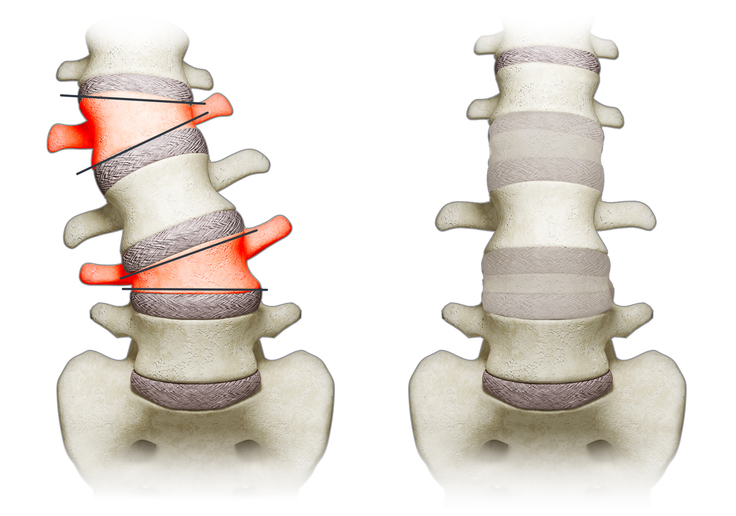
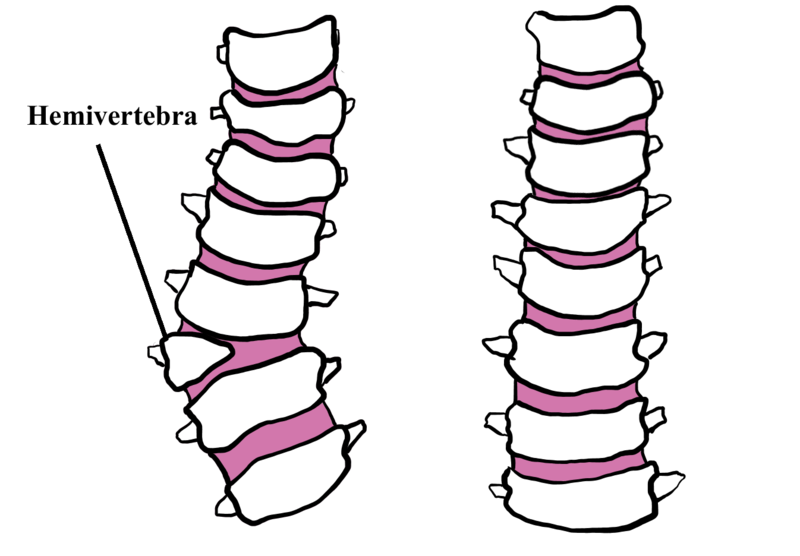
HEMIVERTEBRA:
Hemivertebra are wedge-shaped vertebrae and therefore can cause an angle in the spine (such as kyphosis,
scoliosis, and lordosis). Among the congenital vertebral anomalies, hemivertebra are the most likely to
cause neurologic problems. The most common location is the midthoracic vertebrae.
It is possibly caused by the complete failure of the growth center of one vertebral body. Usually half of
the vertebra involved is completely or partially developed, and the other half is absent. One or more
vertebrae may be involved. The different conditions produce varying degrees of balanced or unbalanced
scoliosis. As a result of the developmental abnormality of the spine, a wedge-shaped vertebra develops,
and adjacent vertebral bodies expand to fit the deformity or tilt to accommodate edge-shaped
articulation.
Depending on the degree of congenital scoliosis involved, any associated deformity may become more
apparent with growth. Other types of hemivertebra, especially those involving unbalanced congenital
scoliosis, usually progress markedly with growth and have a relatively poor prognosis unless early spinal
fusion prevents further spinal curvature. No treatment may be required for the form of the condition
associated with balanced congenital scoliosis.